
Brief Description:
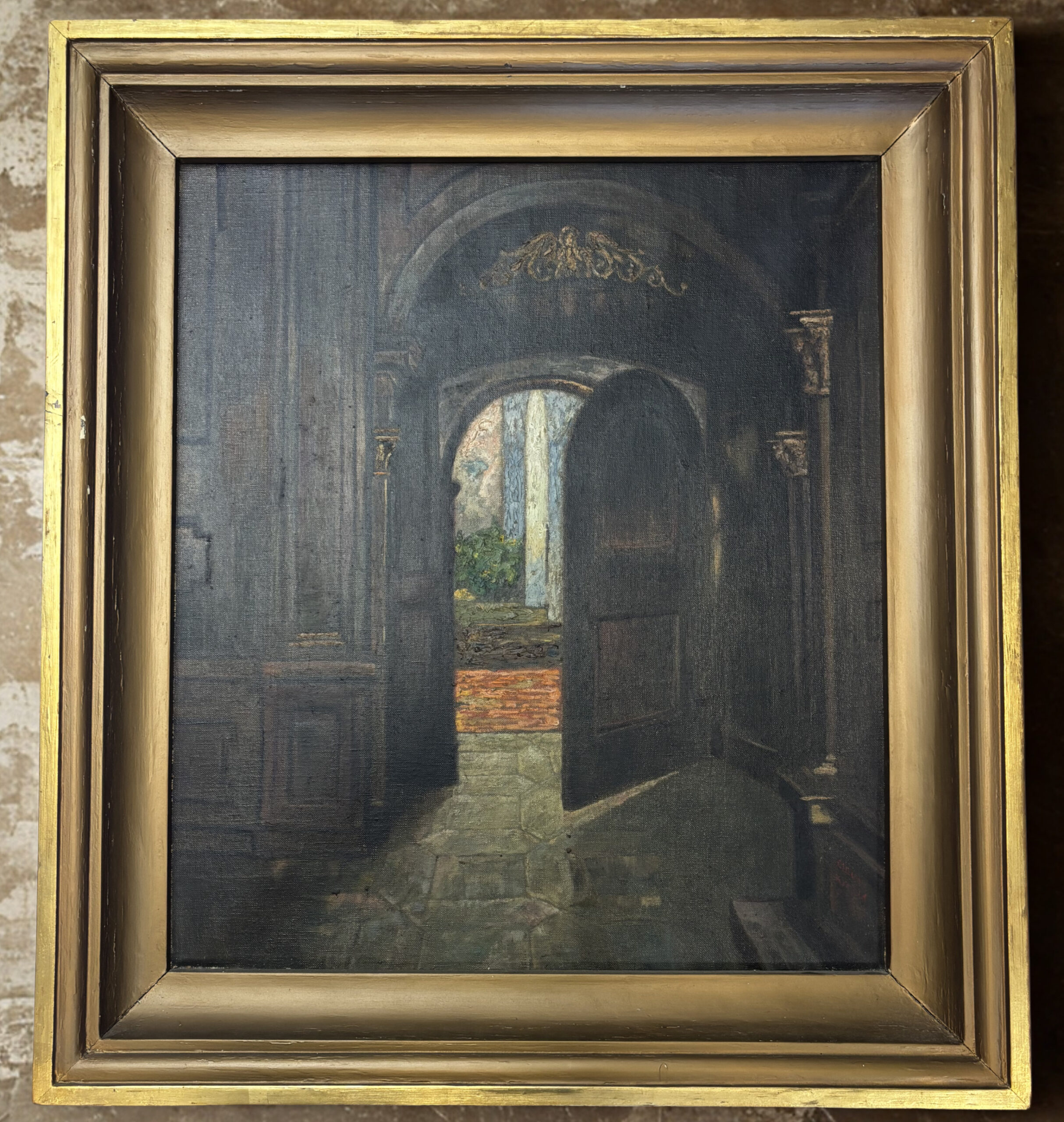
We are pleased to offer for sale a remarkably evocative oil painting from the late 19th century, serving as a brilliant demonstration of light and perspective. The work draws upon the finest traditions of the Dutch Baroque interior (the so-called doorkijkje), capturing an intimate moment of transition between a somber palatial interior and a sun-drenched exterior.
Artistic Execution and Composition:
The central motif of the piece is a massive open door, which functions as a „frame within a frame.“ The artist masterfully employs the chiaroscuro technique—deep shadows in the foreground contrast sharply with the bright light spilling onto the stone pavement and the lush greenery in the background.
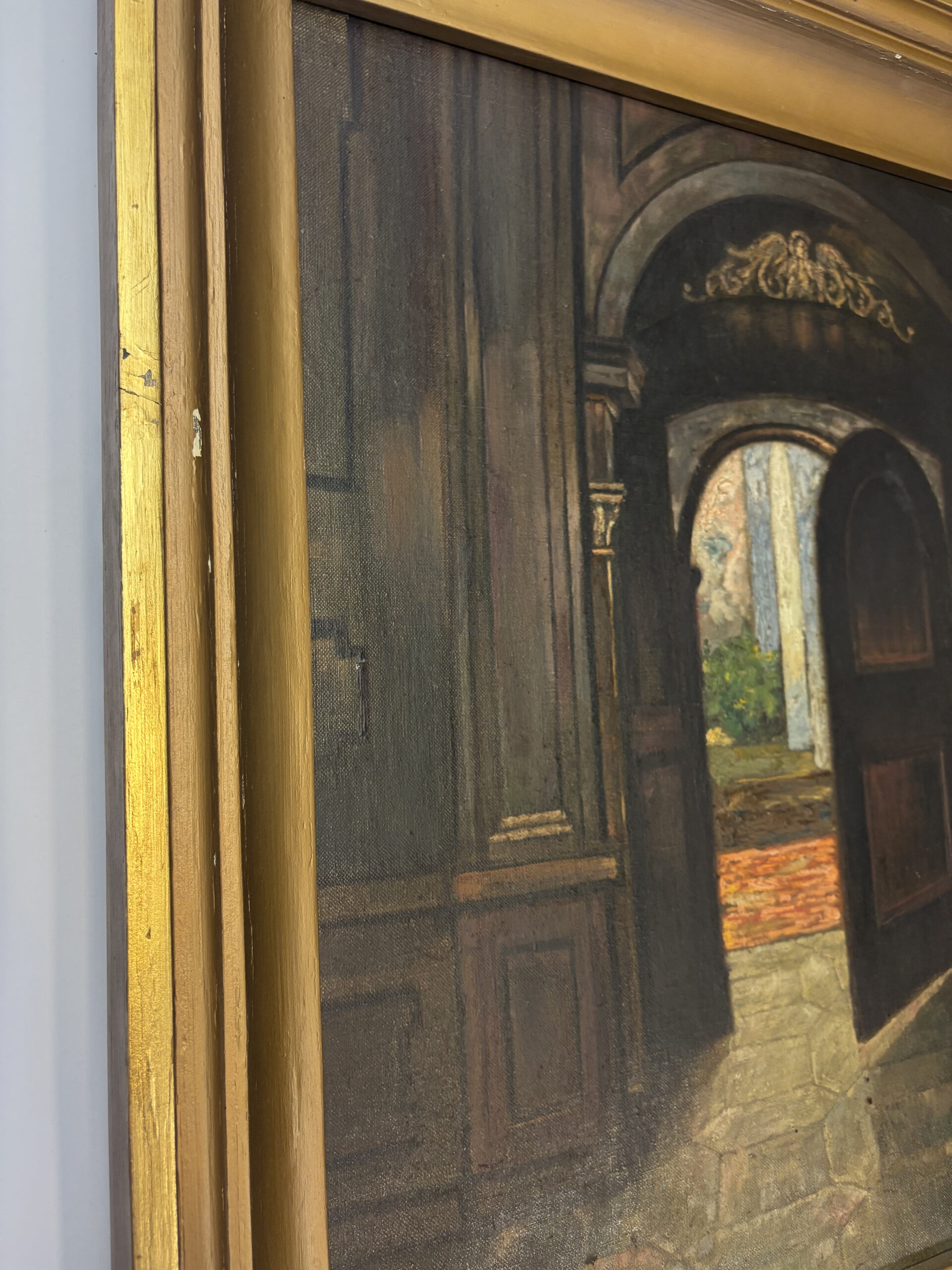
The detailed architectural rendering, including the decorative relief above the archway and the classical pilasters, attests to the artist’s high level of academic training. The painting exudes a serene, almost meditative atmosphere, bringing a sense of depth and mystery to any space.
Technical Details:
- Medium: Oil on canvas
- Period: circ. 1880 – 1910 (Historicism / Late Romanticism)
- Dimensions:
- Framing: Original, distinguished wooden frame with precise gold profiling, enhancing the visual depth of the painting.
- Condition: The work is in well-preserved original condition with a natural patina that confirms its authenticity and age. The canvas is firmly stretched on its original wooden stretcher bars.
Artistic Context and Parallels:
The work bears clear signs of inspiration from European interior painting, a genre defined by the Old Masters. Its treatment of light and spatial depth invites comparisons to the following artists:
- Pieter de Hooch (1629–1684): A pioneer of the „view-through“ (doorkijkje) genre. This painting directly follows his ability to bridge an intimate interior with an open courtyard.
- Samuel van Hoogstraten: A master of perspective whose works frequently utilized the open-door motif to create a trompe-l’oeil illusion of depth.
- Vilhelm Hammershøi (1864–1916): Should the piece be dated to the later end of the spectrum, its minimalist and melancholic atmosphere strongly resonates with the Northern Symbolism of this Danish master.
Although the work is unsigned (or the signature remains hidden), the technical execution suggests the hand of a skilled Central European artist trained in the traditions of the 17th-century Dutch School, likely active within the circles of the Vienna or Munich Academies.
Investment & Collector Potential:
Paintings featuring the „view through the door“ motif are highly prized by collectors for their ability to optically enlarge and brighten an interior. With its sophisticated dark palette paired with a gold frame, this is an ideal centerpiece for classically furnished offices, libraries, or grand salons. This is an investment-grade piece with enduring aesthetic value.

Recenzie
Nikto zatiaľ nepridal hodnotenie.